
Book Club April Review: The Poet Empress by Shen Tao

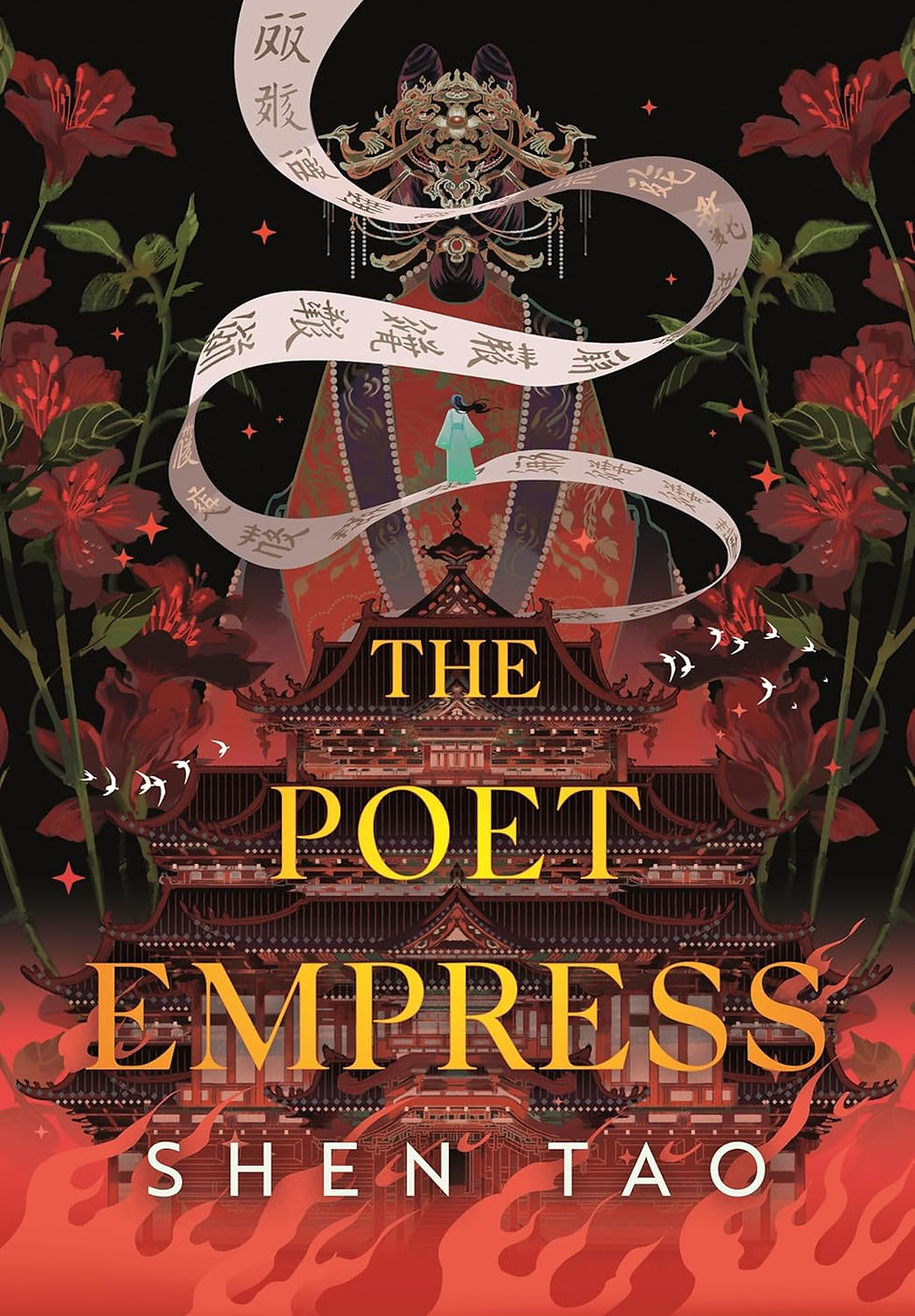
Since April is my birth month, I was excited to find a book that would alter my brain chemistry in the same way that Sword of Kaigen did. Or Mistborn, for that matter. I am tired of predictable romantasies, cliché characters and convenient plot beats. I wanted something that would move me, tug at my heartstrings. I don't exactly remember how I stumbled upon Shen Tao's The Poet Empress, but as soon as I read its blurb, I had a gut feeling that it would be the right choice for the book club.
The Poet Empress follows a rice farmer's daughter who, after becoming the Empress-in-Waiting, has to navigate a web of lies and betrayal within the royal court. Plunged into a ruthless world, she discovers the cruelty of her betrothed and the danger he poses to the entire nation, and decides to write a love poem to kill him.
Our Rating
⭑⭑⭑⭑⭑
Can you actually believe this is a debut novel? Master Tao, teach us your ways! Both Kay and I loved this book and can easily say that it's our current book of the year (within The Shame Shelf as well as in our personal reading journey). The Poet Empress is poignant, touching, and brilliantly written. It doesn't come with any of the awkward dialogues or cheap plot devices that one might associate with debut novels. Moreover, the maturity with which Tao deals with the subject matters at hand is respectable. An easy 5-star read!
***Spoiler Alert*** - We are unable to do the book justice without revealing HUGE spoilers, so please read on with caution!
Our Comments
On Plot: At surface level, The Poet Empress follows a simple plotline. There aren't many subplots that weren't obviously serving the main story, but this simplicity lent strength for the theme to shine through and the characters to grip the reader. I was hooked from the very first sentence ('My sister Larkspur was the fifth child we buried.'), and the pacing was just right to keep my curiosity. The flashbacks were placed in the right spots to give us just enough background information to understand the characters. If I had to find one fault in this brilliant book, it would be the ending in which Wei becomes empress again. For a book that discusses power and corruption, it seemed a bit contradictory for the protagonist to end up in a position of power. But I might be alone in this sentiment.
On Characters: It was easy to root for Wei. She had all the makings of a protagonist with her origins as a poor rice farmer's daughter and her strong motivation to build a better life for her family. She was resilient and shrewd. She had a kind heart but knew when to fight back. It's Terren who fascinated me. He started off as this villain who found pleasure in torturing Wei, and as a reader, it was impossible to excuse his behavior. He seemed so one-dimensional at first, only displaying cruelty and coldheartedness. But then you slowly learn about his past, and you realize that no one is born evil. It's the circumstances that shape a human being. Towards the end, Terren was just a scarred man whose surroundings had failed him completely. Did he deserve to meet his fate at the end of the book? Completely. But, because I was able to understand him better, it made his death all the more tragic.
On Worldbuilding & Magic: Tao managed to build a vivid fantasy world inspired by Chinese history with the way she wove in poetry magic and mixed in rich descriptions of Chinese culture. It was easy to feel immersed in the story, picture the sweet taste of the peaches, or imagine the melodic sounds of the Mid-Autumn Festival. We both enjoyed the magic system, and thought it was a creative and befitting way to supplement the story. Overall, it almost feels like a shame that this book is a standalone.
On Romance: I think the recent rise of romantisies, especially within the enemies-to-lovers trope, has given people the wrong idea of romantic relationships. You can't tell me that your favourite book boyfriend killing everyone in their path for their love interest is not completely unhinged behaviour. Let's not glamourise toxic and abusive relationships just because the male lead has dark features and a six pack. Trust me, I've been there. But this is why I love The Poet Empress so much. Tao doesn't romanticise abuse, and she doesn't take redemption lightly. Due to her brilliant writing, I was constantly warring with myself, questioning how I should feel about the antagonist and whether I could forgive his abuse because of his tragic past.
Would We Recommend It:
CY - 1,000,000%. If you've been waiting for a book to change you, let this be the one. You will be on a rollercoaster of emotions, stringing you along, but at the end of the ride you will learn what it means to be seen.
Kay - 1000% recommend this book. It was a beautiful read.
Book Club Questions:
If you have a book club, or you're buddy reading this with a friend, here are some questions you can contemplate to make your discussion a bit more interesting. And as always, we'd love to hear your thoughts or answers in the comments!
Do you think Wei became a better person at the end?
What did you think of Terren at the beginning of the book? And did your perception change towards the end?
What did you think of the relationship between Terren and Maro?
Do you think a villain is redeemable as long as there is a tragic past? In the same way, do you think every single person can be forgiven if they show true penance?


Comments